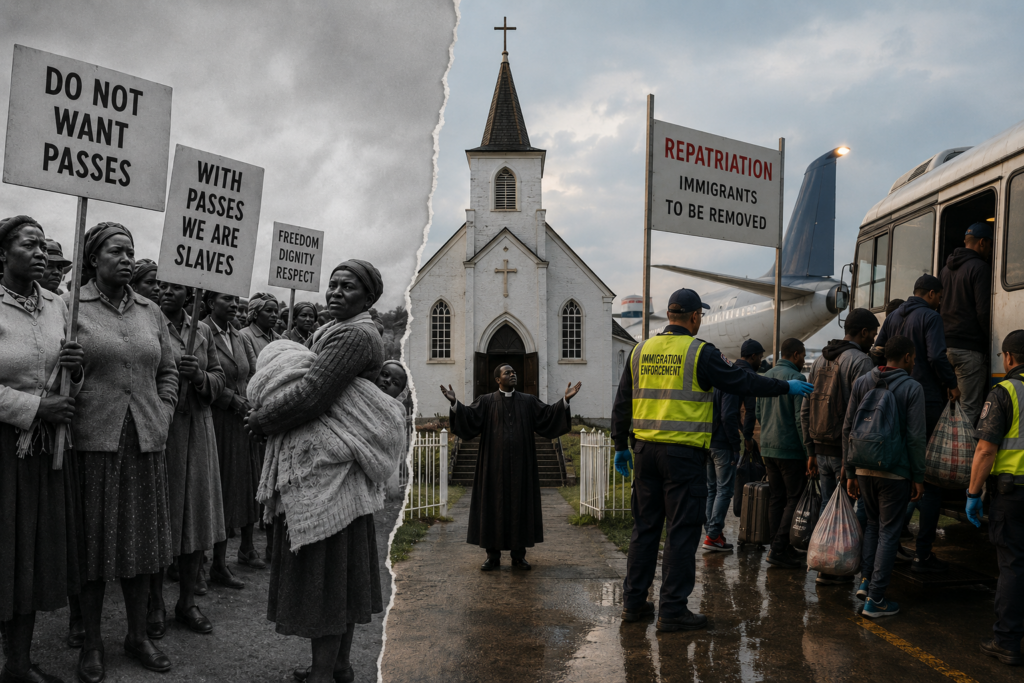
As this Women’s Month draws to a close, we remember the women who stood together against the Pass Laws in the mid 50s, refusing to accept a system that determined where they could live, work and move. Their struggle remains part of South Africa’s memory, and yet this August we find ourselves facing an unsettling reality. We are living in a country shaped by a history of racialised exclusion and control, while once again wrestling with questions of borders, belonging, migration and who has the right to work and build a life here. The contrast is difficult to ignore, and perhaps that is precisely why we need to resist the temptation to resolve it too quickly.
For the past two months, we have been sitting with the violence, fear and pain unfolding around immigration and belonging in South Africa. We have listened to South Africans carrying the accumulated frustration of generations who were promised dignity, decent work, safety and opportunity, yet continue to experience poverty, exclusion and the consequences of a deeply unequal society. We have also listened to our siblings (migrants, refugees and asylum seekers) who are living with uncertainty, fear and the possibility of being targeted, displaced or treated as though their nationality makes their lives less valuable. We cannot minimise either reality, because doing so would require us to turn away from the complexity of what people are actually experiencing.
Holding these realities together is not simply a matter of finding a balanced position between two competing sides. The questions that lie beneath are much deeper and take us into the unfinished work of the borders imposed and inherited through colonial rule, the meaning of African belonging, the realities of sovereign nation states and the rise of nationalism within a country still marked by apartheid spatial planning and profound economic inequality. They also force us to ask who has access to land, work, decent housing and opportunities? Who benefits when undocumented workers can be employed unjustly due to their vulnerability, and why communities already carrying the burden of structural poverty are so often left to experience the consequences of systemic failure.
This is where the conversation becomes particularly difficult. Legitimate frustration about government failure, unemployment, housing, public services and safety cannot simply be dismissed, yet neither can that frustration become a justification for collective blame, intimidation or the dehumanisation of people because they were born elsewhere. The existence of undocumented migration does not explain the structural failures of the South African state, just as defending the dignity of migrants does not require us to deny the material pressures experienced by poor and working class South Africans. We are being asked to hold together realities that are often presented as mutually exclusive. But perhaps rather than simplifying these realities, they deserve the deeper attention of being held together.
There is also a theological complexity that we cannot avoid as a community of believers. This is a moment that calls for deeper engagement than easy language often allows. Scripture has been invoked on many sides of this conversation to defend the stranger, and to defend order and nationalism, often in contrasting ways. Convictions of faith can become another set of slogans in an already polarised debate when they are separated from the histories, power relations and lived realities to which they are being applied. Faithfulness is not simply a matter of finding a verse that supports the position we already hold. It requires discernment, humility and a willingness to let our convictions be tested by the lives of the people whose experiences challenge our assumptions.
For us, this is where sitting with disequilibrium matters; holding the complexity rather than rushing to resolutions becomes part of the work. We are clear that, our preferential bias is with the poor and working class and this conviction does not give us easy answers. Instead, it gives us a place from which to keep asking harder questions about power, belonging, responsibility and justice.
It also requires us to be honest about where we are located within these realities because we are not observers standing outside looking in. Our churches, communities, workplaces and households are intertwined with the systems we are trying to understand. We employ people, share neighbourhoods, participate in local economies, benefit from particular forms of labour and carry assumptions about who belongs and who does not. We therefore cannot approach this moment as though the problem exists somewhere outside ourselves, waiting for someone else to solve it. The questions of migration and belonging are also questions about the kind of society we are helping to create and the ways in which our own practices may reproduce the inequalities we publicly oppose.
Over these past months, we have been listening, bringing people into conversation and supporting practical responses to the immediate humanitarian needs emerging from the crisis. Through the RESPOND Coalition, immediate assistance has been mobilised for people requiring food, transport, care and protection. That work matters because there are moments when people need practical solidarity before they need another opinion, and immediate attention to suffering cannot be postponed until the deeper questions have been resolved. At the same time, relief cannot do the work of understanding and deep systemic engagement. The deeper work requires us to remain in the conversation long enough for our assumptions to be challenged.
This is why, as a community of believers, we have spent these past weeks talking, disagreeing carefully, praying, listening and returning to the same questions more than once. What we seek is the kind of space in which people can remain human to one another while wrestling honestly with questions that are too important to reduce to slogans.
Our commitment, therefore, is not to offer certainty where there is none, but to continue the slower work of dialogue and dignity. This means creating spaces where people can speak honestly without immediately being labelled. Spaces where a South African can express frustration without being dismissed, where a migrant can speak about fear without being reduced to a political symbol, and where Christians can engage Scripture and tradition with careful analysis to ask what consistent faithfulness requires in our current circumstances.
There will be immediate needs, and we will respond to them. There will also be deeper questions that cannot be answered in a moment of crisis, nor can they be settled by choosing what feels like the most comfortable “side”. They require sustained attention, honest disagreement and the courage to remain present when our own assumptions are unsettled.
Perhaps this is part of what the women who marched bravely in 1956 still ask of us today. Their resistance was not simply a rejection of one particular law; it was a challenge to a system that had decided whose movement, presence and dignity could be controlled. Our present moment is different, but it confronts us with difficult questions about the boundaries we draw around belonging and the conditions under which we decide that another person’s claim to dignity is legitimate.
The challenge before us is not to pretend that the histories are the same, but to ask what peoples’ struggles might teach us about the danger of allowing systems, categories and fears to determine whose humanity we recognise.