
Newsletter Editorial By Dr Selena Headley
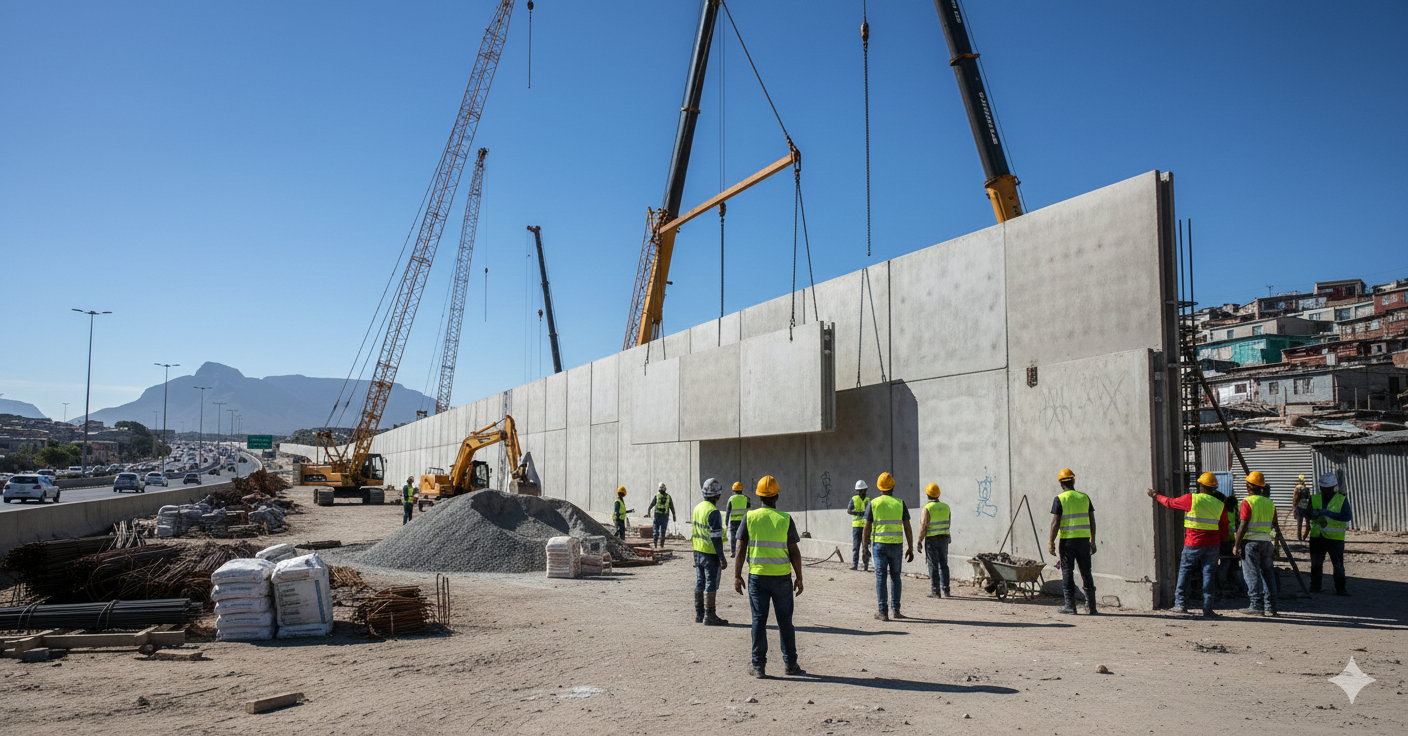
The City of Cape Town has announced a R114 million budget for the N2 Edge Safety Project aka “N2 Hell Run“. They proposed a wall and we are all invited into making a choice, because this is not only a budget decision, but a moral one. It raises difficult questions: What kind of city are we becoming and whose safety do we prioritise? The Mayor speaks of protecting motorists and reducing pedestrian deaths along a nine-kilometre stretch of the N2. These goals matter. Lives matter. The fear we feel on our roads is real. Yet the solution offered is one we know all too well. Reinforce the barrier. Secure the edge. Speed past safely.
It is always easier to build a wall than to build up a community. But easier does not always mean just.
Where are we in the city? Drive the N2 at 120 kilometres an hour and the problem looks obvious –broken fencing, people or animals too close to fast-moving traffic – a threat to our personal security. In those twenty seconds of transit, we feel the urge to lock our doors and look away. But if we slow down and walk at 2 kilometres an hour, the picture changes. We notice the density, the narrow paths, the lack of safe places for children to play, the homes that flood in winter and burn in summer. We notice people living their whole lives on the other side of that roadway edge.
Twenty seconds of deep discomfort at high speed has come to matter more than the daily reality of those who live face-to-face with the crime and poverty we fear. We secure our movement while our neighbours remain locked in place under insecure living conditions.
The history of our edges and walls have always shaped Cape Town. From the colonial hedge to apartheid planning, separation was built carefully and meant to last. While the laws have changed, our infrastructure often still enforces the old divisions.
There is an argument often made in defence of the wall. In many European cities, highways are lined with barriers to reduce noise, protect nearby residents, and make dense urban living safer. This is true. But in those contexts, walls are built to shield people, not to separate them.
The difference in South Africa is not the concrete but the history it carries and the purpose it serves. Here, walls have long been tools of exclusion. They were designed to hide poverty, control movement, and keep certain people “out of sight and out of mind.” When a wall is built primarily to protect motorists moving through an area rather than residents living in it, the barrier echoes that painful past. Context matters. A structure that protects in one place can divide in another, especially in a city still struggling to overcome apartheid spatial planning.
We are aware that part of the argument for the wall is the frequent attacks on vehicles that occur on that road, leading to damage of vehicles, accidents, and injury and death to drivers and passengers. Given that, we welcome the City’s attempt to address these issues. But surely a better strategy would be to address the conditions that so violate people’s very humanity that they resort to crime and violence?
What future do we envision? Jesus tells a story about a man beaten and left for dead on the road. Others pass by on the other side. Only one stops. Then Jesus asks the question that still unsettles us: “Which of the three became a neighbour to the man attacked by robbers?” (Luke 10:36).
Walls allow us to pass by without seeing. Out of sight becomes out of mind. We protect ourselves from discomfort and call it safety. But Scripture keeps pulling us back to a different standard: “What does the Lord require of you but to do justice, love mercy and walk humbly with your God?” (Micah 6:8). Are walls all we can imagine for the future of our city? Can we really wall out danger while leaving people locked inside the very conditions that produce it? God is already at work behind the N2 Edge—among siblings and neighbours, churches and community leaders, parents and young people refusing to give up. We can choose a different future, one where we build with God and our neighbours, a city without walls, brick by brick and relationship by relationship.
How might we respond? As communities of faith, our calling is not to withdraw but to draw near. Proximity matters. Transformation rarely happens at 120 kilometres an hour.
What if we slowed down? What if we used our voices to ask the City to match its spending on barriers with equal investment in the people behind them? What if we supported the gardens, the youth programmes, and the small businesses already fighting for life along that stretch of road?
Jesus says, “Do to others what you would have them do to you” (Matthew 7:12). This is not abstract. It is deeply practical. At the Warehouse, we go behind the dilapidated fences and find vibrant faith communities. We see people keeping children in school, creating work where there is none and planting gardens so food is shared generously. This is the “church without walls.”
A closing question from Dr Martin Luther King Jr: “Life’s most persistent and urgent question is, ‘What are you doing for others?’”
With the power we have – whether it is the power of a vote, a voice, or a budget – how will we respond? We can choose walls that protect our comfort or communities that protect our common humanity. We can pass by on the other side, or we can stop, see, and act. Let us appeal to our highest aspirations to act with honour, care, and bravery towards our neighbours. Let us be hard on unjust systems and soft towards people. Let us insist on a city that works for everyone, not only those who can afford to speed past.
Join us. Walk with us. Pray with us. Use your power to build up communities so that safety is shared and dignity is not optional for some residents. God has not abandoned our neighbourhoods. Neither should we.